LOCALIZER · R HIP
plane 4/12 · 1:30
plane 4/12 · 1:30
Slate.MD is a modern PACS and reporting system for teleradiology groups, imaging centers, and community hospitals. PHI stays on your premises, the backend lives in the cloud, and every workflow was designed by someone who eats the latency too.
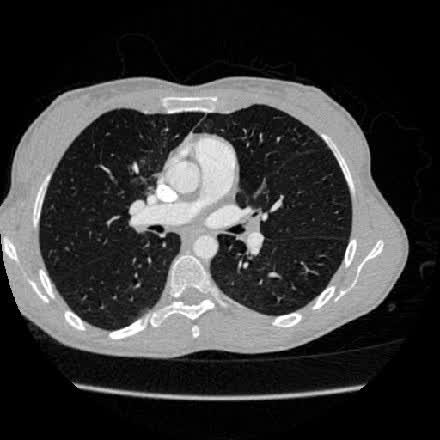
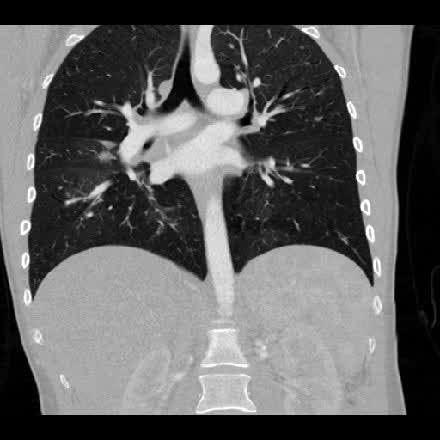
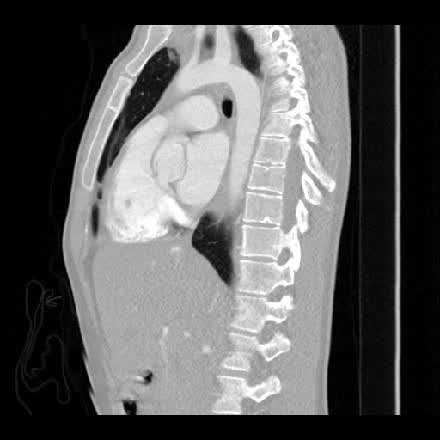
Real study, whole stacks: 301 thin-cut 1.0 mm axials plus every reformat the scanner wrote, served straight from the appliance archive, no video, no mockups; the amber line under a pane is how much of a stack has landed. The tools really measure: mm, degrees and areas come from the true 0.66 mm pixel spacing, ROI means are approximate HU inverted from the rendered window, measurements stay on their slice, a click on a label deletes. W/L presets re-window every pane and zoom is linked across them. The 2x2 volume MPR is rebuilt in the browser from the thin axials; drag the crosshair center to move the point, grab a line and the other two planes re-slice oblique while the pane under your hand holds still. The measurement tools work inside the MPR too: a measurement lives on its plane and clears when that plane moves. Off the toolbar: ↑↓ scrub, p toggles a 5 mm thin-MIP (3 mm steps) on the pane under the cursor, in either view, i inverts, Esc cancels or disarms. Case from the COVID-19-NY-SBU collection, NCI Imaging Data Commons, CC BY 4.0, de-identified.
Click a target and the viewer sets up: 12 radial planes sweep the femoral neck in 15° steps, clock-labeled, the angle tool armed on each. Every value lands in its report row.
Stylized illustration in the viewer's language.
A beautiful, responsive, fully featured PACS that just works is not a premium tier. It is the default this was built from.
Dictate the way you read: you never speak a comma or a period, punctuation and capitalization land for you. Each finding routes itself to the right organ section as you speak, the engine deciding the section from what you said, not from where the cursor sits. Findings supersede the normal they contradict, and the impression drafts itself from your findings and the patient's prior reports. Call it thirty seconds a report; across a sixty-study shift that is roughly half an hour of your day back, on the reporting side alone. A scripted replay of the shipping workflow, no video.
The demo shows the transcript half. The same engine drafts the impression from your findings and the patient's prior reports, streaming as it writes: an ungrounded number kills the draft mid-sentence, and a sentence that can't be proven faithful stays in your verbatim words.
Legacy PACS make you glue five products together. Slate.MD is the worklist, the viewer orchestration, the dictation, the structured capture, and the report, with AI working the whole path: findings route themselves as you speak, the impression drafts itself from your findings and priors, and the chart is read for you, never asserting what you didn't say. One system, one browser tab.
Deterministic ordering: STAT, then TAT-breached, then oldest. Turnaround targets and breach states are visible per row, tuned per site.
Hip/FAI radial reformats with manual alpha, center-edge, and version capture flowing straight into the report. More subspecialty modules follow the same pattern.
Every monitor filled, every scroll instant, backed by a workstation-memory cache with honest fidelity tags. One keystroke to a 2×2 MPR with draggable oblique crosshairs; slab thickness and spacing live on the function row, W/L presets on F1–F8. It feels tuned because it is: nightly, on a multi-monitor rig, by the radiologist who reads on it.
Browser mic to on-site speech recognition: instant partials while you talk, a rescoring pass behind them, audio that never leaves the building. Findings route to the right organ as you speak, punctuation and the impression are drafted, and it learns how you say words. Voice runs navigation and signing: say “sign report” to finalize, with an explicit confirm before any instant release. Live now, on real dictation.
Dictate findings in whatever order you read; each utterance lands in the right organ section, and the report builds in your own template language. The impression drafts from your findings and the patient's prior reports (yours and a colleague's), while a number grounded in none of them aborts the draft mid-sentence. If a restyled sentence cannot be proven to say exactly what you said, your verbatim words stand. Radiologists lose ~80 minutes a shift wrestling dictation into a report; this workflow takes them back.
It reads the prior studies, the requisition, and the chart, and hands you what matters: active problems, meds, recent imaging, labs, each cited back to the source record. We don't know anyone else pointing a VLM at the radiologist's own workflow like this.
A PHI-aware context pane surfaces the patient's story where you read it. A comparable prior's stable findings (even across modality: a CT cyst follows you into the MR) arrive as one-click chips in your own phrasing: "left renal cyst measuring 1.3 cm, unchanged / increased / decreased." A complex or indeterminate lesion on the prior blocks sign until you've measured it today; a simple cyst never holds up your signature. Named interval procedures ("interval ACDF at C5–C6") drop into the right section, attributed, one click to dismiss; a vague "s/p ACDF" stays in the pane rather than guessing. Nothing is asserted for you.
Slate is the surface best-in-class imaging AI plugs into, not another tool to bolt on. A CT head with a hemorrhage can be at the top of your worklist the moment it lands: the sickest cases surfacing first, results landing where you already read.
Four-view hanging by view and laterality, BI-RADS capture with density language, and the MQSA audit statistics your physicist asks for. Diagnostic rendering rides a cleared mammo viewer.
Whole-slide viewing for tumor boards and consults: gigapixel pyramids, micron-true scale bars, the same appliance. Review use; primary-diagnosis pathology has its own clearance path and we say so.
Coronary calcium scoring, vessel centerlines, and LV volumetrics, running today behind an investigational banner while we walk the regulatory path properly. Never in the clinical read.
The phases we're building toward: every organ and structure delineated the moment a study lands, and every prior registered to today's case, the same anatomic level under your cursor across years of studies, the lesion you measured last time found and offered, never asserted. Device-track work, behind an investigational banner until it earns its clearance.
On-prem appliance. PHI never leaves your network by default. The subprocessor list is nearly empty on purpose. And the audit log can prove its own integrity.
Admins cannot open studies. Emergency access exists: break-glass with a written reason, a hard expiry, and loud auditing.
AES-256-GCM envelope encryption for sensitive payloads on top of full-disk encryption, with key rotation that doesn't re-encrypt your archive.
Every control mapped to its Security Rule citation in our architecture whitepaper, with implemented vs. planned labeled honestly. Request the whitepaper.
Send us twenty sample HL7 messages before the kickoff call. Our conformance linter returns a gap report (which fields map, which priority codes need translation, what your Z-segments carry) so the interface meeting is a confirmation, not archaeology.
Orders in, results out, with per-site field mapping as configuration, not custom code. Your RIS puts the accession somewhere unusual? That's a setting.
SMART on FHIR launch from the chart with patient context, plus FHIR reads for the clinical summary. Cerner and Meditech follow the same standard path.
The client probes each workstation and picks its rendering strategy (full client volumes on a workstation, appliance-side rendering for thin clients) with the reasons shown on the diagnostics page.
Incumbent PACS pricing is a ransom note with a renewal date: seat license, modules, interface fees, a maintenance line that grows every year. Ours is one number against the thing you actually do, a study read, and right now it is design-partner pricing, locked on one call. No rates printed yet, by design: the first three groups set them with us and keep theirs for two years past the pilot.
Twelve months, roughly half of intended list locked for two more years, a weekly thirty-minute call, and a product shaped around how your group actually reads. If your PACS is the thing everyone complains about, talk to us.
hello@slate.md